
Amelesia Not Dementia – Unmindfulness Not Madness
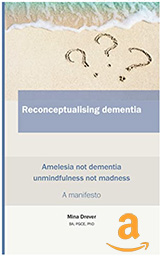
Manifesto: reconceptualising dementia
Amelesia not dementia – unmindfulness not madness
To reconceptualise dementia we must:
- abolish the use of the word dementia and adopt Amelesia – a much kinder word
- stop saying that people with mental decline are not the person they used to be
- rethink the concept of time and space
- learn to communicate with Amelesians.
Mina Drever
BA, PGCE, PhD
View Manifesto on Amazon
PREFACE
Amelesia not dementia – unmindfulness not madness
I have been thinking about dementia for well over twenty years now and I have become increasingly concerned at how a condition that affects us mostly (but not exclusively) as we get older is being sensationalised.
The headlines are frightening and very disturbing:
- Millions with eye conditions at higher risk of dementia – The Guardian 21-Sep-2021
- Widespread pain may be an early warning of dementia – The Times 17-Aug-2021
- Someone gets dementia every three minutes – Facebook headline by the Alzheimer’s Society (March 2020)
- Boy, 4, with dementia has forgotten how to say ‘Mama’ – The Times 26-Apr-2018
- Dementia now causing one in eight deaths – The Times 07-Aug-2019, Greg Hurst, social affairs editor (statistics from the Office for National Statistics)
- High blood pressure causes dementia – https://healthline.com
- There are over one hundred types of dementia – https://trinityhomecare.co.uk
I started questioning this ‘dementia’ in the late twentieth century, when my mother was diagnosed with vascular dementia in her mid-seventies. So many questions crowded my mind that I thought I would explode.
- What is dementia?
- What is vascular dementia?
- Why is everybody treating my mum as if she is stupid?
- Why can’t they just accept what she is saying, even if it is wrong?
- Why can’t they see that she gets upset when they ask her ‘Have you forgotten already? I just told you!’
- Why did the doctor say that we have to accept that she is not our mother any more?
- Why is she being dismissed like a naughty child who doesn’t know how to participate in a conversation?Why do carers talk down to her?
- Why can’t she just pay attention? (I could read this in their exasperated sighs.)
I started venting my anger and frustration onto paper. A few years later, after she had suffered these humiliations for over a decade and after she had died disappointed with her family for having ‘abandoned her’, a memoir emerged in which I endeavoured to give the credibility to the last ten years of my mother’s life that she would have wanted.
It is difficult to express in words exactly what I mean. She wanted to be believed. She wanted her desires and wishes to be granted. She wanted to be respected for knowing what she wanted to choose and decide. By herself. For herself. If she believed that night was day and day was night, it mattered to her. Why did the people around her not believe her? And why did they tease her about her mistaken reality?
The first paragraph of the memoir, which I eventually published, encapsulates succinctly what I thought of how my mother was perceived by other people and, consequently, how she was spoken to and how she was treated:
They say that your mother has gone. They say ‘she is not your mother any more … The disease has taken over her mind … The dementia has disconnected her from her rationality …’ But this is not so. Angela never stopped being the person that she had been. Right to the end of her last breath she never stopped thinking about other people and their needs … The past and the present became one … Time and space were unified in the reality of remembered episodes, bursts of memories that presented themselves to her mind in cinematic snapshots.
Since this memoir was written, my theories have been reinforced by my voluntary work as a visitor to Redbond Lodge residential care home in Great Dunmow (Essex). I sit and chat with people whose mental abilities have been affected by some sort of damage caused by obscure disturbances in their brains. Many of them have been diagnosed with ‘dementia’. As they tell me stories of their lives, the people they like to sit with and why they prefer certain television programmes to others, I get to know each individual’s character. I can imagine clearly the tolerant mother, the fiercely proud civil servant, the fun-loving sailor, the proud business man, the patriotic resistance fighter of the Second World War, the dedicated community gardener, the passionate music teacher.
I am more convinced now than I was when I started writing my memoir about my mother’s life during her ‘dementia’ years that when our minds become impaired by some brain disease that we cannot see, we do not stop being the person that we used to be. Our minds wander freely, without any conscious control on our part, between historical and present events.
Because people listening to our mental meanderings do not know our past, they assume that we do not know what we are talking about. If we confuse the person in front of us with someone from our past, they assume that we no longer know the important people in our lives. But we just cannot remember. Sometimes we cannot find the right words. But we know what we want to say, if only the appropriate words would come to our lips, and if only ‘they’, those listening to us, would just give us the time to think!
Do you remember what it feels like to try to speak in a foreign language when words from your first language jostle for supremacy over the alien phrases that rush to the periphery of your memory bank? I sometimes can almost see the brains of the people I speak within the care home working in this way. I can certainly feel them as they pierce me with their eyes as if to say ‘Just give me a moment …’
This frustration and these questions over the years have developed into a desire to revolutionise the way we envisage the minds of people affected by dementia and our relationships with them. To help us do that I have formulated the following statements of intent.
1. Abolish the term ‘dementia’ – a most insulting word, dementia is a label that has done enormous psychological damage to relationships between those with brains affected by a number of different physical conditions (such as Alzheimer’s and Lewy body) and those with healthy brains; it has disempowered entire families, as well as professionals; it has diminished the very essence of the person.
2. Adopt the word Amelesia – I constructed this term from two Greek words: Ameles means unmindfulness and the suffix –sia means the condition or state in which we find ourselves. Amelesia describes perfectly where the damaged brain is: elsewhere, anywhere but ‘here’ and ‘now’.
3. Recognise the permanence of the core inner person – our inner core self remains for others to reach out to despite the increasing absence of coherence when communicating our most basic of needs, never mind our more esoteric thoughts and dreams.
4. Reconceptualise time and space in the disabled mind – the decreasing ability of our working memory to stay ‘in the moment’ and the increasing tendency of our mind to meander and wander into the time and space of our collective life experiences, in order to make sense of what is happening ‘now’, leads to a fusion of time and space in our mind.
These goals are realistic and can be achieved. The paths have already been laid by numerous people. My aim is to tap into the voices that have spoken before me to show you, firstly, that the time has come to be brave and courageous in going against the grain and, secondly, that it is perfectly possible to do this in a constructive way.
With this manifesto, I explain my four intents in some detail, what I can present in their support and how I hope to alter our perception of dementia. I will start with an introduction to these intents and why I consider it necessary to reconceptualise dementia.
View & Buy the Amelesia Manifesto on Amazon
[1] Mina Drever (2017). Thank You Lady. Austin Macauley Publishers, London.