
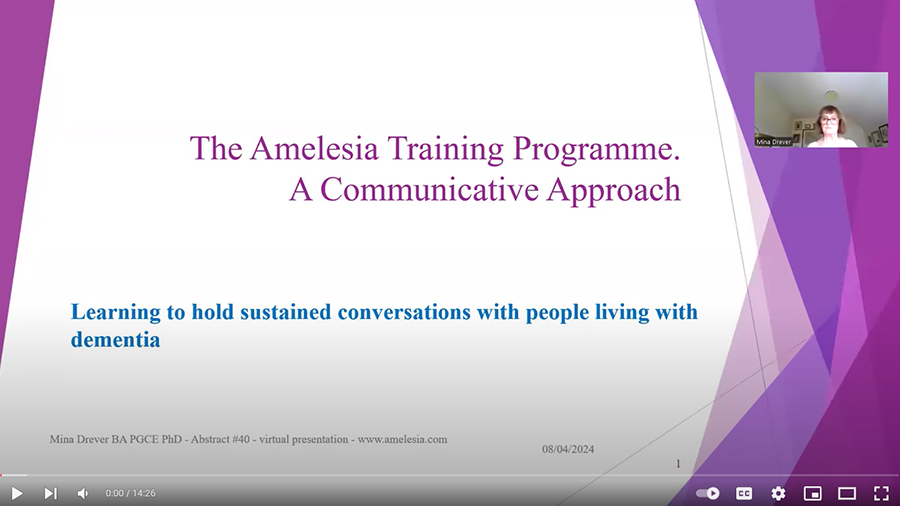
A very busy conference. Too busy and too many overlapping themes. Too easily lost among the attention-seeking noise of too big a conference.
Having said all that, I was absolutely delighted to have this chance. It means that a panel of expert reviewers of abstracts deemed this Amelesia work worthy of being heard. It means that this approach has a place in the world of education.
Whilst disappointed at the total absence of interest in the Amelesia Approach during the conference or subsequently, I have determined to continue with this work.
I need to continue for all the people in care homes so wilfully deemed too mentally impaired to be worthy of being heard. Their words are deemed unreliable – still, after all the education and awareness raising: a large theme at the conference.
Trailing through the contributions at this conference, there is so much work on raising awareness and on education going on around the world, why is it not permeating down to the ground floor, where the ‘caring’ takes place: in the dining room of care homes, in the ‘dementia’ entertainment village halls, in hospital wards?
Some presentations at the ADI’s 36th conference focused on the use of language surrounding diseases of the brain and how language impacts on the way the person diagnosed with these diseases are perceived.
In Japan, in Canada, in Turkey, in Sweden … all over the world people are exploring countless approaches to reducing stigma through raising awareness. A few focus on communication, but not very many.
Effective communication with people living with cognitive impairment resulting ofrom brain damage is the only tool for eliminating the notion that people living with ‘dementia’ are not able to communicate.
Learning how to hold effective communication with people living with Alzheimer’s is the only way to make them feel good about themselves.
Without this communicative tool, there will always be tears of frustration shed in care homes’ bedrooms and in care homes dining rooms, in hospitals and in private living rooms. ‘
This Amelesia Communicative approach has a role to play in eliminating the stigma and I will continue with this work for as long as it will take.